
1. Introducing the BioCircuit Consciousness Theory
Exploring the theory that consciousness is everywhere and we're just the receivers.

Who is this guy?
Good question.
I’m not a neuroscientist, philosopher, physicist, or mystic. I don’t have a doctorate in consciousness studies (though yes, that’s a real thing). I’m not writing from a lab bench or a meditation cushion in the Himalayas.
I’m a semi-retired software executive with a long-standing obsession with how things work, especially the weird stuff. I’ve spent most of my life building tech, leading teams, and navigating systems, both digital and human. But in the background, I’ve always been chewing on bigger questions: Why does consciousness feel so strange? What connects all living things? And why does so much of the “official” story about the mind feel like it’s missing something?
This theory, the BioCircuit Consciousness Theory, is my way of putting those thoughts into the world, not as facts, but as a framework. It’s part science, part systems thinking, part spiritual curiosity, and part good old-fashioned late-night wondering.
I’m not claiming to be right. I’m not trying to convert you. I’m just opening a door that might lead somewhere interesting.
If you’re here for that kind of exploration, welcome.
I’m figuring it out too.
BioCircuit Consciousness Theory (BCCT)
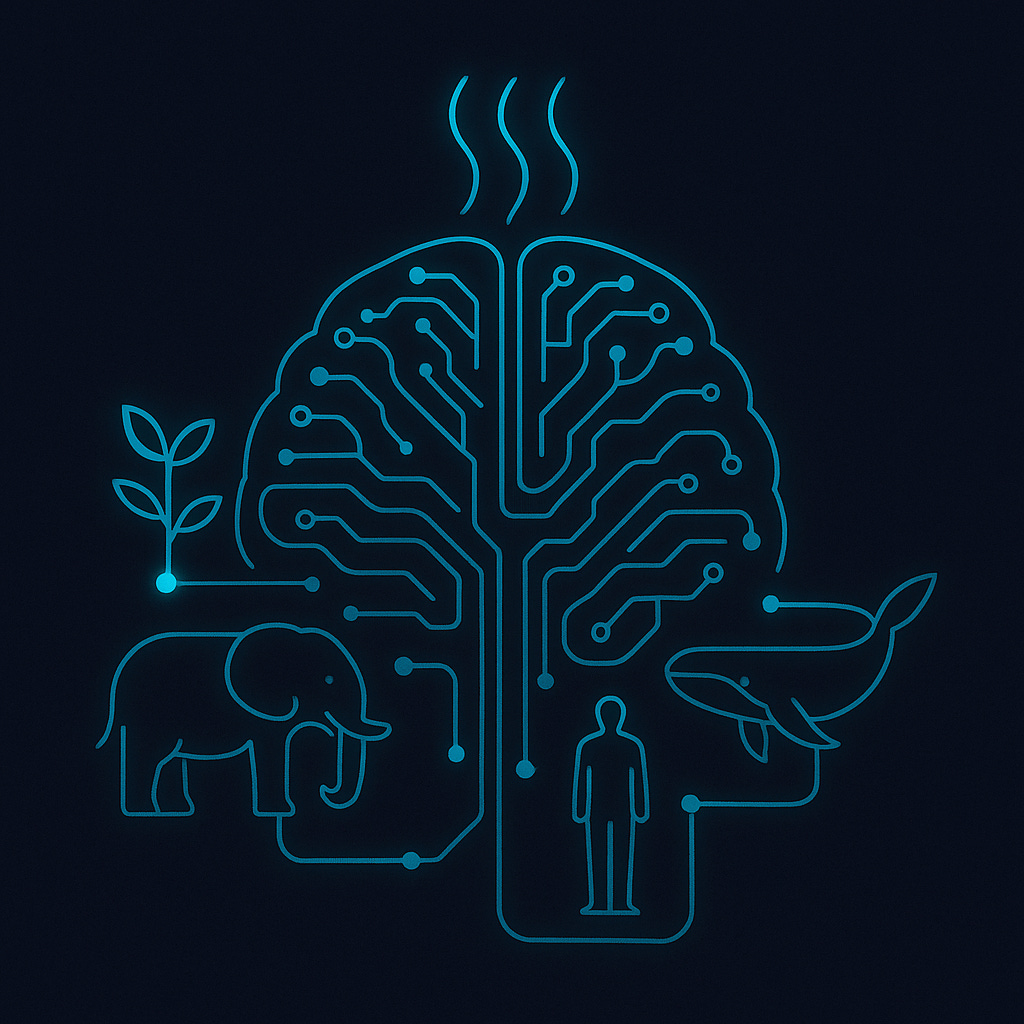
What if consciousness isn’t produced, but rather it’s received. And every living thing, from you to a whale to a single tree, is part of a planetary-scale circuit designed to modulate that signal. This is the first in a series exploring that idea: The BioCircuit Consciousness Theory.
What if we’ve been asking the wrong question all along?
Science and philosophy have long assumed that consciousness is something the brain creates, a byproduct of neural complexity, evolutionary biology, or emergent computation. But what if that assumption is fundamentally backwards?
What if consciousness isn’t something we generate?
What if it’s something we receive?
This is the central question behind a new way of thinking I’ve come to call the BioCircuit Consciousness Theory or BCCT for short. It’s a framework that pulls from neuroscience, physics, systems theory, and metaphysical philosophy to suggest that consciousness might function more like a signal than a substance. And that our brains, and the brains, bodies, and even cells of other organisms, don’t produce that signal, but tune into it.
The Brain as Receiver
Let’s start with the metaphor at the heart of it all: the radio.
A radio doesn’t create music. It detects and translates a broadcast signal. Depending on how the radio is built - its hardware, its fidelity, the quality of its tuning - it can receive more or less of the signal. Sometimes it picks up static. Sometimes it catches something beautiful.
Now imagine the human brain not as a generator, but as a receiver. A living, evolving transducer capable of tuning into a universal consciousness field, or “signal,” that surrounds and permeates existence.
Every person is born with a different “radio,” just as every animal, plant, or organism possesses its own kind of receiver. The shape, capacity, and calibration of that receiver determine what kind of conscious experience can be tuned in, and how much of the broader “signal” is available to that being.
And just like with real radios, sometimes the reception is crystal clear. Other times, it’s full of static or even completely disrupted.
A Planetary BioCircuit
In this model, life on Earth isn’t a random collection of conscious beings. It’s a circuit: a vast, interconnected web of biological receivers.
Some of those receivers are simple. A single-cell amoeba might pick up only the barest flicker of the consciousness signal, enough to interact with the world, but not to reflect on its own existence.
Other receivers are complex. Whales, elephants, primates, and humans have increasingly refined tools for modulating and amplifying the signal. They don’t just sense reality, they reflect, interpret, remember, and imagine.
Every living entity plays a role in this circuit. Some are processors. Others are capacitors, resistors, filters. Some modulate frequency. Others ground the signal. Like components on a motherboard, lifeforms don’t all perform the same task, but they all serve the overall flow of consciousness across the system.
This is why Earth supports such immense biodiversity. Not just because it can, but because it must in order for the circuit to remain stable, adaptive, and coherent.
Consciousness as Signal, Not Substance
The idea that consciousness is a kind of signal reframes nearly every conversation we’ve been having in science and spirituality.
It explains why consciousness can feel unified yet individualized, elusive yet ever-present.
It suggests that lifeforms don’t create awareness, but they express it.
It hints at the possibility that consciousness isn’t even of this Earth, but something more fundamental, perhaps intrinsic to the fabric of the universe itself.
And it opens the door to entirely new ways of thinking about mental illness, dreams, memory, paranormal phenomena, and the mystery of death. Each of these may represent different disruptions, anomalies, or transitions in signal reception and integration.
The Origins of BCCT
As previously mentioned, I didn’t come to this theory in a lab. I came to it through decades of thinking about the mind, exploring spirituality, navigating loss, reading about physics, working in tech, observing nature, and confronting the strange and wonderful mysteries of being alive.
Like many of you, I’ve always felt there was something more, something missing from the standard scientific model of consciousness. The reductionist explanations never seemed to account for the richness, continuity, or weirdness of experience.
The BioCircuit Consciousness Theory is my attempt to put a new lens on that mystery.
And I want to be clear: I don’t claim to have the answers. This isn’t dogma. It’s an open framework, a model-in-progress. But it’s one that I believe has explanatory power, and creative potential, far beyond what we’re used to hearing.
Why This Series Matters
Over the coming weeks and months, I’ll be using this Substack to lay out the core principles of BCCT and explore their implications.
We’ll tackle questions like:
Where does the signal come from?
Why are there so many forms of life and what do they do in the circuit?
How do mental illness, dreams, or altered states relate to the tuning of the receiver?
Is spirituality a form of intentional re-tuning?
What happens when the receiver breaks or dies?
Could quantum entanglement be linked to identical receiver patterns?
Are plants conscious or do they serve another role in the BioCircuit?
What happens to reception when we leave Earth?
I’m hoping this won’t just be a blog but a collaborative field journal. I want your questions, insights, skepticism, and suggestions. If you’ve ever felt that traditional models of consciousness are missing something… this is a space to explore the “something.”
Who This Is For
If you’re a scientist or philosopher, this theory may challenge the foundations of what you’ve been taught. That’s a good thing.
If you’re spiritual or mystically inclined, BCCT might give language and structure to what you’ve intuitively sensed.
If you’ve had strange dreams, near-death experiences, déjà vu, psychic moments, or just an unshakable feeling that life is more than neurons firing… you’re in the right place.
And if you’re skeptical? Great. Your questions will sharpen the model and keep us honest.
Final Thoughts
This is just the beginning. But I believe the BioCircuit Consciousness Theory has the potential to unify what science can’t explain, what spirituality struggles to prove, and what we all feel in our most profound moments of awareness.
We are not islands of consciousness floating in a dark sea. We are transmitters. We are receivers. And we are, all of us, part of something larger than ourselves.
I’m glad you’re here.
Let’s start tuning in.